Pokazywanie postów oznaczonych etykietą Civil Aviation. Pokaż wszystkie posty

piątek, 6 listopada 2015

Mitsubishi Regional Jet about to fly next week

 Testing the new jetliner

The Mitsubishi Regional Jet has already completed a few taxi tests and recieved an approval from the Japanese 
transport ministry to complete it's first flight on the 9th of november (Monday). However, this isn't the original date of the first flight. The plane was suppost to complete it by the end of october, but the plans were changed by the later mentioned issue with rudder pedals. Mitsubishi has simulated “normal and abnormal scenarios” and that no issues have been found. Currently, during taxi tests only one, small problemn with the rudder pedals. When the rudder pedals are under extreme condition, there was “interference to the linkage mechanism of the rudder pedal”. In mid 2016 the first MRJ-90 is going to be flown to the US for additional test flights.
About the Mitsubish Regional Jet
The Mitsubishi Regional jet is Japan's first airliner after the NAMC YS-11 from the 1960s, designed by Mitubishi Aircraft Corporation (ironically, it's its first aircraft). The plane has a range comperable to the ERJ-19x series aircraft, with similar seat number and performance. The MRJ is slightly cheaper, but more expensive than the Russian alternative-the Sukhoi Superjet.Currently 223 have been ordered, 150 by leasing companies.

piątek, 22 maja 2015

Forgotten Flight 902

At 20:54 an airplane was seen on soviet radars. 25 minutes later the aircraft entered Soviet airspace in the area of Kola peninsula. It was an intruder, that had to be shot down.
KAL902
Korean Air Lines Boeing 707 Fitzgerald.jpg
From Wikipedia
In the 70s many US/NATO reconnaissance aircraft spying the USSR would fly in from the area of the North Atlantic or even the North Pole. It was a high tension area. Times were different. Civilian aircraft wouldn't fly from Europe to Asia like they do today, over Russia.
Korean Air Lines flew their aircraft from Paris to Seoul via Anchorage, Alaska using a Boeing 707. On April 20 1978, one of those flights, KAL902, took off from Paris Orly Airport. A total of 109 people were on board. The route to Anchorage took the 707 over the UK, Norwegian Sea, northern Greenland, quite close to the North Pole. Both magnetic and "physical" Pole.

KAL902's route (from Wikipedia)
The airplane had no INS (http://aerostudents.com/files/avionics/InertialNavigationSystems.pdf), nor GPS. Due to errors with calculating magnetic declination, when over Ellesmere's Island, the plane turned right. The proximity to the North Pole played the biggest role in making this mistake. Afterwards, the plane passed over Svalbard, then Barents sea, closing the USSR border. With no ground reference, as the areas of north Greenland or the Arctic Ocean are pretty much the same to the route flown after the change of course, Korean pilots didn't realise their mistake. They might haven thought about it, but maybe they were to tired, lazy or basically trying not to think, that they did something wrong.
Soviet radars spotted the plane at 20:54, while 400km away from the border. They first assumed, that it was one of naval aircraft from Murmansk, coming back from it's mission, having not changed his IFF code. At 21:19, flying over Kola Peninsula, the 707, with crew unaware of the danger they have flown into. On the ground, Su-15 pilots were ordered to take off and intercept the intruder. Mach 2 capable, the Su-15 would be able to intercept the slow flying 707. 
Sukhoi Su-15
From Wikipedia
One of the pilots, Alexander Bosov, identified the planes as the RC-135. The RC-135 is a reconnaissance aircraft design, based on the 707. Another thing that proved bosov to be right was the "Maple leaf" on the intruder's tail. The Su-15 pilot thought, that the RC-135 (in fact 707) belonged to Canada, a NATO country. The commander told the base about his faulty observations. Why faulty?The Leaf was actually a stork with spread leafs and Canadian Air Force never operated the RC-135, nor any military 707 variation (A 707 was used for VIP transport).

Korean 747-SP. The "maple leaf" can be seen on the tail.
From Wikipedia
Soon, Bosov noticed, that the aircraft is in fact civilian, having Chinese characters on the tail, and the maple leaf, an airline logo. Bosov radioed the base, correcting himself, and saying that the airplane is civilian.

Source: Wikicommons
According to ICAO, an interceptor should fly up to the intercepted aircraft from the back, and then outrun the intercepted aircraft and stay in front of the intercepted airplane on the left side of it. The interceptors should wave their wings, which the intruder should interpret as: be aware and do what I order you to do. The intercepted airplane should do the same thing as the interceptor, showing, that they understand. Then, the interceptors should guide the intruder down to the closest airport or outside the border of the country (which in the intruder has flown into).

F-18 intercepts a Tu-95, USAF photo.
At the time, captain Kim (captain) noticed, that something is clearly wrong. The appearance of soviet aircraft showed, that he is far of course. The captain switched landings on, in order to show, that he is going to follow the Soviet aircraft. He tried contacting the Su-15s. But there was no response.
kal 902 1
From Wikicommons.
Meanwhile the Soviet commander was ordered to fire at the Korean airliner. The commander-Alexander Bosov tried to convince ground about the fact, that the intercepted aircraft was civilian. Despite the fact, ground still ordered an attack on KAL902. The first missile (R-60 missile) missed the 707. The second missile, the same type, hit the left wing. The part of the wing fell off. It was about 3,5-4 metres long. Debris hit a part of the passanger cabin, causing a decompression and killing two people.
R-60 missile.

kal 902 2
From Wikicommons
The last part of the flight isn't known in 100%. The crew descended the 707 from 30 000ft. KAL902 disappeared from Soviet radar. However, the sot down part of the wing was still on radar and mistook it as some kind of missile, dispatching another Su-15. The commander, Alexander Bosov  was replaced, after his aircraft began running low on fuel. Meanwhile the 707 was searching for a place to land. Only one Su-15 followed the plane. The Sukhoi's pilot was probably trying to make the plane land in a Russian Air Base.
The Korean aircraft was still flying for about 40 minutes, close to the Finnish border around the region of Karelia. In April, most Karelian lakes are frozen. Captain Kim was trying to find one, in order to put his plane down. He attempted to land several times, however his efforts were all in vain. The 707 finally landed on the frozen Korpijarvi Lake in Karelian ASSR, around 140km from the Finnish border. The touchdown was very rough.
Crash site photographs: http://ilmari.puheenvuoro.uusisuomi.fi/78410-lento-kal-902-v1978 http://englishrussia.com/2008/06/03/the-korean-boeing/#more-1961
Korean Air Lines 902 on land.jpg
Crash site photograph (from Wikicommons)
After two hours 107 survivors were rescued from the crash site by Soviet helicopters. The rescuers first saw Coca-Cola, Beer or read western newspapers and magazines.  Two people were dead, mainly because of the decompression, however details aren't known. Survivors were flown to the town of Kem.After two days passengers were released to  the US consulate, in Leningrad. The crew was kept in Murmansk, and later formally apologised. Afterwards, they were released, too. In the end, everyone was flown back to Seoul and payed $100, 000.

An L-1011 equipped with INS. (From Wikipedia)
Who was at fault? At first, Korean Air. Why? In 1978 the INS was already in use. The shootdown plane didn't have such equipment. This mistake would have not been made, if an INS had been installed. Due to the proximity of the North pole, the route could have been changed, as well as stopovers. Perhaps a Paris-New York (Chicago, Toronto, Boston)-Anchorage (Seattle would make it, too, as well a Honolulu)-Seoul route would be better and safer. However, this isn't all. Soviet pilots were unfamiliar with ICAO procedures. There always night have been a situation, with a civil, non-Soviet airliner. This didn't happen. Quite importantly, the ground officers played the biggest role in the accident. There are a few things, that can explain decision, though they can be questioned (especially the third argument). The first one is that, they might have been tired and weren't sure, about what they were doing. Perhaps what Bosov said wasn't conviencing enough, If he sated, that "It might be a civilian plane, etc.", the ground could still think, that the 707 was on a spy mission, instead of a civilian flight. The third argument, is that ground could think, that a spy plane uses a civilian livery, in order to trick everyone out.
The lesson from KAL902 wasn't learnt. Later on, similar events happened. One of them KAL007, was eventualy one of the most tragic air disaster at the time, when it happened. 269 people died. Luckily, Cold war ended in 1991.
BTW
Remember, aviation is the safest way to travel! Don't forget about it!
SolsticeMiGsmall (7633859414).jpg
Mig-21, a soviet fighter jet. (Source: Wikipedia)


poniedziałek, 6 kwietnia 2015

Is the Dreamliner really so Awesome?

The Boeing 787 Dreamliner is a long-range, mid-size wide-body, twin-engine jet airliner developed by Boeing Commercial Airplanes.
This is the Wikipedia (http://en.wikipedia.org/wiki/Main_Page) description of one airplane I'm going to talk about. What should I say? The "Dreamliner" really pisses me off. Yes, it does. The media make the Dreamliner the greatest plane ever and get really excited about it. In adittion, when the Dreamliner has problems or other difficulties, they make it a big event. Yesterday a LOT 787 had to come back from Warsaw Okęcie airport due to turbulence. Some smart person commented, that there would be no news, if the plane was for instance different. I agree.  Technically the Germanwings crash made media talk more about air crashes.
Know, I really want to see, if the dreamie (that's how I'll call the 787) is soo good (KFC, life tastes great).The list is going to be full of numbers. Some information might not be exactly 100% correct, but I tried my best researching. The first categories are a little bit messy, but since the third, there is a table showing the specifications.I'll compare it with the A330-300, A340, 777-200, A350-900, 767 and Il-96. The Il-96 is just for fun. Let's see.
 BTW
1.Please write some constructive comments about some posts I could do. Please give me some topics to cover, etc.  It really motivates me! :D
2. Write down your opinions about the 787 in the comment section please. Do you think it's so great? Do you agree with the "result"of the comparison? etc, etc. Thank you.

Avionics, pilotage, crewman.

Dreammies cockpit photo taken from Wikipedia.
FMCs, FBW, EICAMSes, MFDses. Typical boring modern cockpit. The difference between A330, 340 and 777s is that the displays are more functional and a the layout of displays is just a little bit comfortable for pilots. On the other hand there isn't a lot of blank space. The dreamie is better, but yet again not so much as some people expect it to be.
The A350 XWB is different, having a similar type of displays, however Airbus keeps the typical joystick where it usually is in modern Airbuses. The CDU (FMC), whereas the buttons are on the side. Dreamies keep the usual Boeing 777 design. Other than that, the overhead is very similar. All in all, the 350 has no yoke and is more spacious.
 A350 cockpit. Source: Wikipedia and Joao Carlos Medau
The 767 is much older, but yet again the cockpit uses some(but eventually very little) glass styled instruments, the overhead is quite similar. The 767 isn't better. Let's face it, the Boeing 767 is now old. The Il-96 (-300) needs three crewman. Ups, fail. Then again, it has a lot of good, sturdy avionics. Eventually, most gauges are in Russian. The 787 is way better.

Il-96 cockpit.
Overall, the 787s cockpit is quite decent. It is some more better than the A330/340 and Boeing 777. Some other large jets, Ilyushin 96 and Boeing 767 are also worse than this airplane. However the A350 XWB might make you feel like it's the more advanced plane. in the end I in a way understand the fact that people get excited by dreamies avionics.
Passenger capacity
An average Dreamliner carries about 270-290  (290-max. for the 787-8, 270min. for the 787-9).

787-8 interior. Source:Wikipedia
Average A330 can carry from 250 to 375(rare 330-300 configuration) passengers. The average is 312 (312.5 actually). All in all the 787 and A330 are quite similar, with the airbus being slightly (very slightly) better. The thing is that the A340 (most versions) are bigger than 787s. The smallest 340, -200 version carries around 270 passengers.
The Triple Seven is a little bit different. The Dreamliner was designed to replace the 767. Indeed not the triple seven. The larger -300 version takes up to 380, whereas the 787-9-310.
Aircraft landing approach. Side view of twin-engine jet in flight with flaps and landing gear extended.
Random 777-300ER picture. From Wikipedia.
A350 XWB is pretty much the same as the Dreamliner. However, having a little bit more space in the cabin, I guess passengers might prefer the XWB. The difference is yet again quite small, but IMHO the A350 is better.
The Il-96 interior picture taken from Wikipedia.
The Il-96 isn't as good as the XWB. A typical Il 96-300 carries around 240 people on-board. A 2-4-2 seat layout is also possible. I don't think anyone will need this information, as only 29 Il 96 airplanes were built. The 767-400 carries only 250, being bigger than the 787-9 and -8. Definently another sign showing, that the dreamie replaces the 767.
All in all, the dreamie isn't really shocking in case of passenger.Nothing special. The A350 and 777 are slightly better, along with the Airbus A330 and 340.
Takeoffs and Landings
The Dreamliner's MTOW is 228 000 kg. The takeoff distance at MTOW is around 3 000 metres. The 787-9's requirement is a 2 900 metre runway to takeoff. The 787-9's MTOW is 253 000kg. A 787-8 requires a 1650 metre runway for landing at MLW (maximum landing weight-I'm not sure if such an abbreviation exists) of 172 000kg. The -9 version needs around 1800m of runway to land at it's MLW (193 000kg). These are just facts, remember.
787-9 picture by BriYYZ from Wikipedia.
Here comes the A330-200, with a MTOW of 242 00kg. The T/O (takeoff) distance is 2 770 m. It looks as the dreamie isn't so awesome. However, I understand the MTOW difference, as the A330-200 is slightly bigger than the 787-8.  The -300 series MTOW and T/O distances are the same as with the -200. Not the best achievement. All in all, both A330 and 787 are similar in case of takeoffs. With a MLW of 182 000kg, the A330-200 needs around 1 800 metres of runway to land. The -300 series and -200F has a MLW of 187 000kg, but has the same landing distance of 1 800m. Again, the 330 and 787 are very similar. Kind of a draw, however the dreamie is much younger and meant to be better than a 90s widebody jet from a rivaly company.
My favourite Airbus -A340 is quite similar to the 330. In case of MTOW, the smallest one- A340-200 can takeoff at a weight of 275 000 kg. Considering the size, better than the Dreamliner. The -300 version's MTOW is 276 500 kg, I thought I'd be something around 290 000 kg. Compared to the Dreamie, it's a mediocre score. I won't tell you about the -500 and -600 series, as they are much larger than the 787, and it doesn't really make sense to compare them. The T/O distance for an A340-200 at MTOW is 2 990 metres, whereas the 300-3 100m.

Small A340-200.
Courtsey of Wikipedia and Anthony Noble.
The A340-200's MLW is 185 000 kg, and the -300-190 000. The A340-200 needs 1 900m, whereas -300 2 000 metres. Again, not a STOL airplane. The A340-200 being similar sized to the 787-9 requires a runway of similar length, however can land being heavier than the rival. It looks like a draw.
The 777-200 (-300 is too big) has a MTOW of 247t and the T/O roll distance (T/ORD is the abbreviation I made up) of 2 450m, the -200ER series- 297,5t and with a 3 380m T/O distance, whereas the -200LR-347 500kg. The -200LR's takeoff distance is 2,8km. With an impressive MTOW, the takeoff roll distance of the -200LT version beats the 787-8! That isn't agreat improvement Boeing.
Now study the 777-200 MLW; the first one is the -200, -200ER, and then -200LR:
Maximum landing weight445,000 lb
(201,840 kg)
470,000 lb
(213,180 kg)
492,000 lb
(223,168 kg)
The MLW landing distance, beginning with the -200, -200ER and then -200LR:
Landing field length (MLW) m (ft) 1,550 (5,100ft)
Landing field length (MLW) m (ft) 1,615 (5,300)
Landing field length (MLW) m (ft) 1,600 (5,250)

Aircraft landing approach. Front quarter view of twin-engine jet in flight with flaps and landing gear extended.


Majestic looking 777 Source: Wikipedia

Looks very good, beating a lot of other airplanes. No wonder why the 777 doesn't have to be replaced.
What about the A350-900? Good question.
Maximum takeoff weight268 t (591,000 lb)
Maximum landing weight[146]205 t (452,000 lb)
The MLW is quite impressive, whereas MTOW-not so much. The T/O distance is 2 830m, quite similar to the Dreamliner -9.
The MLW landing distance is only 1300m! I couldn't believe it at first however it's achievable.
What about a fun Il-96?
Large tail, winglets and cool engines. Il-96 in Beijing.
Credit: Mark Tang and Wikipedia.
Max. Landing Weight183,000 kg (403,083 lb)220,000 kg (484,581 lb)
Max. Take-off Weight250,000 kg (551,000 lb)270,000 kg (595,000 lb)
                                      -300 version                    -M version
This aircraft isn't as popular as the Dreamliner, however the specifications of this plane are a little bit better, especially with the -300, which is nearly the same size (not shape) as the typical Dreamliner (787-8).
With the same order as above, I'll show you the Il-96 T/O and landings specifications.               
MTOW T/O roll distance: 2 340m (96-300) 3 000m (96M)
Landing distance (not quite sure if it's MLW) 900m (!) 1 800m


The landing distance for the -300 is quite impressive. The M versions specs aren't as good. It may be bigger and the avionics- improved, however the landing and takeoff specifications not.


350,000 lb
(158,760 kg)


412,000 lb
(186,880 kg)


450,000 lb
(204,120 kg)
      
767-300          -300ER          -400ER            


That is the 767s MTOW.
7,900 ft (2,410 m)8,300 ft (2,530 m)8,600 ft (2,621 m)10,200 ft (3,109 m)
Now the T/O roll distance for the 767 models as above.
767-300 variants MLW:

767-300: 136 078kg 767-300ER: 145 150kg.
The 767-400ER can land weighing 158 757 kg.
The 767-300(ER) can land at a 1 800m runway at MLW and the -400ER-2130m.
All in all, in the end the dreamie's score isn't impressive. it isn't a STOL airplane, it isn't a revolution incase of landing and takeoff economics. It's good. Just good.


czwartek, 19 marca 2015

About Russian, Ukrainian and Soviet airliners. Part 1

Hi,
It's time for some nice photos of the loud, smoky or rare aircraft from the West. the list goes in a chronological way, staring with the earliest planes. This part takes is until 1963, the aircraft are sorted chronologically by their first flight. The Yak-40 is excluded from part 1, as it's quite important and I'll be nice to begin Part 2 with that plane.


Ilyushin Il-12 and Il-14
Ilyushin Il-12 OK-DBN CSA Orly 27.05.57.jpg
Ilyushin Il-12 (35046).jpg
Aeroflot Ilyushin Il-14 at Arlanda, November 1970.jpg

People and the Il


The Il-12 was a small, radial engine airliner, first flown in 1945. The planes engines were changed twice, the aircraft was meant to carry only 21 passengers. There were several problems with the prototype, such as centre of gravity issue. The Il-12 was delivered to Aeroflot in 1947 and to LOT Polish Airlines in 1951, also used in Laos, Romania, Bulgaria, China, Mongolia and North Korea (still used in 1960s). The Ilyushin was eventually unsuccessful, though in my opinion it led to a nice development-Ilyushin 14.
In 1950, the Il-14 took its first flight. the plane was similar size (21m. long, 31 wide), the engines were improved along with payload capabilities. Thus, flight dynamics were improved. Il-14s (Nato code: Crate)were used by airlines and militaries. 1,348 were totally built, produced since 1950, until 1960. They were manufactured in Czechoslovakia (being called Avia-14), China (known as Y-6) and East Germany. The Ilyushins were flying in Indonesia, Cuba, Congo or Algeria.There are three Il-14s flying in Russia, used on air shows, not commercial service.
Antonov An-8
Aeroflot Antonov An-8 Osta.jpg
Antonov An-8 AN1089511.jpg


The Antonov 8 was first flown in February 1956. Produced in Tashkent 1957-1961, it didn't become popular being used in a few African countries, Sri Lanka, the UAE, Spain and Soviet Union. The plane was a protoplast for the later Antonov designs. There were plans of a fuel tanker version or a Navigation trainer. Another version- the rocket boosted -8RU crashed during testing killing seven crewman and was abandoned. The last An-8 was flown in 2004 and retired.
Tupolev Tu-104 and 124


Aeroflot Tupolev Tu-104B at Arlanda, July 1972.jpg

Drag chute in action.


The Tu-104 was the second jet to enter regular airline service, though it flew into the sky in 1955, which was the sixth result. The design was based on the Tu-16, therefore many Tu-16 pilots could fly this magnificent plane. An interesting fact was that the plane used drag chutes, shortening the landing distance by 400 metres. The engines were placed close to the fuselage, like in The De Havilland Dh-106 Comet (and making it very noisy).
The crew consisted five men, two pilots a navigator, Flight engineer and radio operator.The plane was heavy, making piloting hazardous, in addition the Tu-104 was fast on finals.
The plane had a decent (2, 750km) range and was used in the Soviet Union, Czechoslovakia (CSA) and the Mongolian military. The last, 201st Tupolev 104 was built in 1960. 36 were involved in accidents and incidents. The deadliest one was caused by spatial disorientatiuon, killing 122 people on board.


The Tu-124 was smaller and had worse capabilities (25% smaller). The plane was also a less popular, between 1960 and 1962 164 were produced and delivered to CSA, Interflug, Aeroflot, Iraqi Airways, China Air Force, Indian Air Force Czech Air Force, Iraqi and Soviet militaries. The plane was relatively cheap and the operational service wasn't  expensive. Retired in 1980 by airlines, they were in service for the next 12 years with militaries.
Antonov An-10/An-12
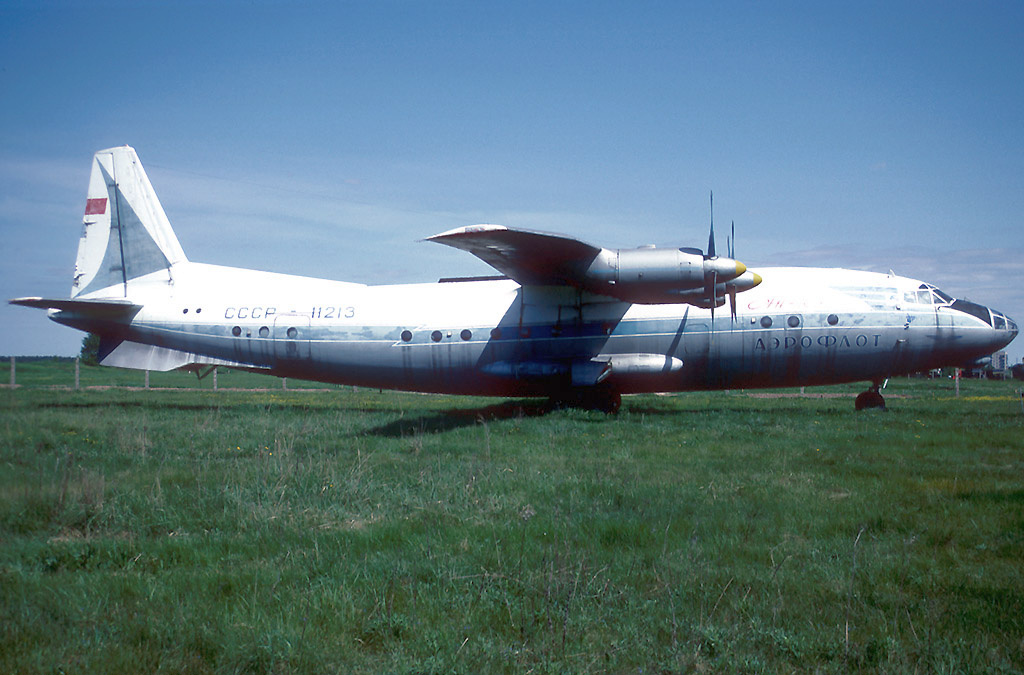
Aeroflot An-10A CCCP-11213 Monino 1992-6-4.png


This Antonov project was built for civil aviation, it had four engine, was 34m long and had a 38 metre wingspan. The first flew in March 1957. I'm talking about the Antonov An-10 Ukraina, meaning Ukraine. The production began in 1959, and the plane entered service with (only) Aeroflot. It could be easily converted into a military plane. Until 1960, 112 were built. The plane could fly at a speed of around 345 knots Ground speed. The range was 2530 miles. The plane was a decent performer, more economic than the Tu-104, but had more problems, such as stability issues, causing two crashes, along with icing problems and similar situations. The plane continued service, but its fate were two crashes in the early 70s, one killed 122 people, when both wing separated due to structural failure. The Antonovs fuselage hit woods close to Kharkiv. The airline decided to cease Ukrainas operation.
Gomelavia Antonov An-12 Mutzenberg.jpg


At the same time, a better plane was developed, though its performance and size was fairly similar. There were and still are numerous of An-12 flying in many versions. Made to operate remote airstrips, the plane was quite popular in Africa. The Antonov was also built in China as Shaanxi Y-8.
The plane is used in Africa, Europe and Asia, from Angola to Poland (Bias Me), Indonesia and Afghanistan. Sturdy.
Ilyushin Il-18


Ił-18 Sił Powietrznych Federacji Rosyjskiej


 In my opinion, it's one of the greatest aircraft ever built.Another old and sturdy Ilyushin. The il-18 was a 1946 abandoned programme, but in the 50s, a design of a new prop began. The plane was pressurized, it had a nose radar and was the first Soviet airplane with autoland systems. The plane looks to be sturdy, right. Over 15 versions were built, since 1959 to 1978. More than 850 were built. The planes size was comparable to the An-12, with similar speeds but a better range. The takeoff and run distances were bigger, but the Il-18 was also used on remote African runways.
As an airline, you could chose two engines, Ivchenko Ai-20M or AW-68. The cabin was quite spacious, but the aircraft was noisy and sometimes vibrated a lot. The Ilyushin could carry from 100-120 passangers. The plane was flown in for example Cuba, Djibouti, North Korea (still), Egypt and Yemen. Three ones are still operational, possibly the youngest one would be 37 years old, if it was built in 1978 (the last). Not bad, as some 47 year old An-12s are still serviceable.This plane can be considered safe in my opinion, better than An-10 Ukraina. Overall, quite nice, sturdy and advanced for it's times.
Tupolev Tu-114
Aeroflot Tupolev Tu-114 JAL livery APM.jpg


Tupolev bureau was meant to design a long range aircraft in 1955. The airplane was based on the Tu-95 Bear bomber. The name was originally Tu-95p (passenger), but initially it became Tu-114 "Rossiya". The changes were fairly tiny, small cockpit design features were changed along with the fuselage design. The engines were the same as with the Tu-95, they are also implicated on An-22 aircraft.
 Due to the large engines and props, the gear was placed relatively high. The plane could reach an amazing speed of 880 km/h, 55 knots faster than boring 737 jets. Sorry, but this plane is too boring, despite -200 version being quite interesting and sometimes even extreme. In fact Boeing 707 jest or Dc Douglas 8 (Dc Douglas, he he) aircraft reached similar speeds. The rang was also quite impressive, 9700 km. The plane flew from Moscow to Tokyo in a JAL friendship repaint. the ceiling was decent, 38-39000 feet.
Tu-114s carried from 120-220 passengers, operating on intercontinental routes, such as Moscow-Havana(via Conkary), Belgrade, New Delhi and Montreal. The plane had a dinning lounge and sleeping beds, like the older American Boeing 377 Stratocruiser. Only 32 were built since 1958 to 1963.  The plane was retired in 1976, only one Tu-114 was lost. They were replaced by jet Ilyushin 62 aircraft. Sadly, because the Tu-114 was an outstanding airplane. Luckily replaced by another great liner.
Antonov An-24


The Antonov An-24 was first flown in 1959, being designed earlier. It was built to replace the older Il-12 and Il-14 aircraft. An advantage of this plane was the fact, that it was turboprop powered. The plane is prepared for operating at extreme airports, such as ones with short runways, gravel strips, but also ones with minimal ground service. The cabin was considered noisy, however the airliner was quite popular with Warsaw Pact airlines, along with poor African countries.
The safety, well..... there were a few problems with icing causing crashes. 152 An-24s were lost out of 1367 (along with the Chinese version, a topic later on). About two dozen An-24 versions existed or were planned. There is also a Chinese version-XianY-7, along with a modernized avionics airplane called Xian MA60.  The production of An-24s started in 1959 and ended- 1979. They ares still operational in North Korea, Russia and Ukraine. Nearly all Warsaw Pact countries used An-24s (both as civilian and military airplanes). Somewhat the Wests Fokker F-27 Friendship.
Ilyushin Il-62


One of my very favourite aircraft. A beautiful, but dangerous plane. I'd love to see the Project Tupolev Il-62 in FSX so much, I'll even pay for it.
In 1957 the Tu-114 was developed, a long range Soviet airplane. Shortly, Ilyushin (Tupolevs rival) wanted to design a long range jetliner, in order to replace Il-18s and Tu-114 aircraft. This design was fairly similar to the British Vickers VC-10, just bigger. The first one flew in January, 1963.It had a unique feature of four engines at the back. Due to the weight they created, while on the ground, there was a gear at the back so that the plane doesn't fall back. The Ilyushin had a pressurized and air conditioned cabin, considered a little bit quitter than Il-18s or Tu-114 due to the engine positioning. The plane had a cruise speed around 820 km/h, range of 7000 km, carried around 170-200 passengers. At a length of 52 metres and wingspan of 43 it was a large airliner, longer than Boeing 707s or the early Dc Douglas Dc-8. The design had one issue-engines. Both NK-8 and D-30 engines had major flaws, such as turbine bearings, causing two deadly crashes in Warsaw.
The plane was introduced in 1967. The primary user was Aeroflot. Il-62s were also used in Czechoslovakia, Cuba, West Germany and Poland. The plane was leased by Air France, KLM and JAL. A modernised version was built in 1974, the -62M,one if its new features was an additional fuel tank in the tail section. Despite having decent operational abilities, the plane had difficulties with being loaded, making the flight preparation time quite long. A positive aspect of the plane was that pilots enjoyed flying it and liked.
292 Il-62 aircraft were built between 1963-1995. 10 of them are still flying. 22 hull loses occurred.
Sadly they aren't safe on their position, probably their fate is being changed. Hopefully by some cool plane. Cool- no A320 and 737.
Tupolev Tu-134


With time, the standards of aircraft grew higher and higher. The Tu-124 was now considered old and uncomfortable. Tupolev designed the -134, a plane made to be closer to the Western standards. The angle of the wing caused difficulties and pilotage hazards. First suppose to be called Tu-124A, the new plane featured wing modification and later on thrust reversers. The performance was different along with different engines. The cabin could fit 96 people, 40 more than the Tu-124.
The plane began service with Aeroflot in 1967. It was soon tested in Poland for BCAR, an airworthiness test. BCAR enabled the Tupolev to fly in western countries- the test was ICAO related.. It was quite revolutionary, as the Tu-134 was Russian. Russian wasn't a member of ICAO. In the end the plane was certified, but considered noisy. It also had an impact on the cabin noise.
Between 1966-1984 854 Tu-134 aircraft were built. They were quite popular with Warsaw Pact nations, along with many African operators. The Tu-134 is considered popular and 18 are still operated in Russia, North Korea and Sudan. The Russian operators are phasing out most of their Tu-134s, due to the crash of RusAir flight 9605, that sadly killed 47 people. Afterwards, Dimitry Medvedev Another notable crash occurred in October 1986, when pilots of a Mozambique (I tired to make it an adjective) presidential Tupolev had problems with navigation while landing in Maputo, crashing in South Africa, killing 33 (and the president).